Exploring Fábio Machado´s Artworks and his Interpretations
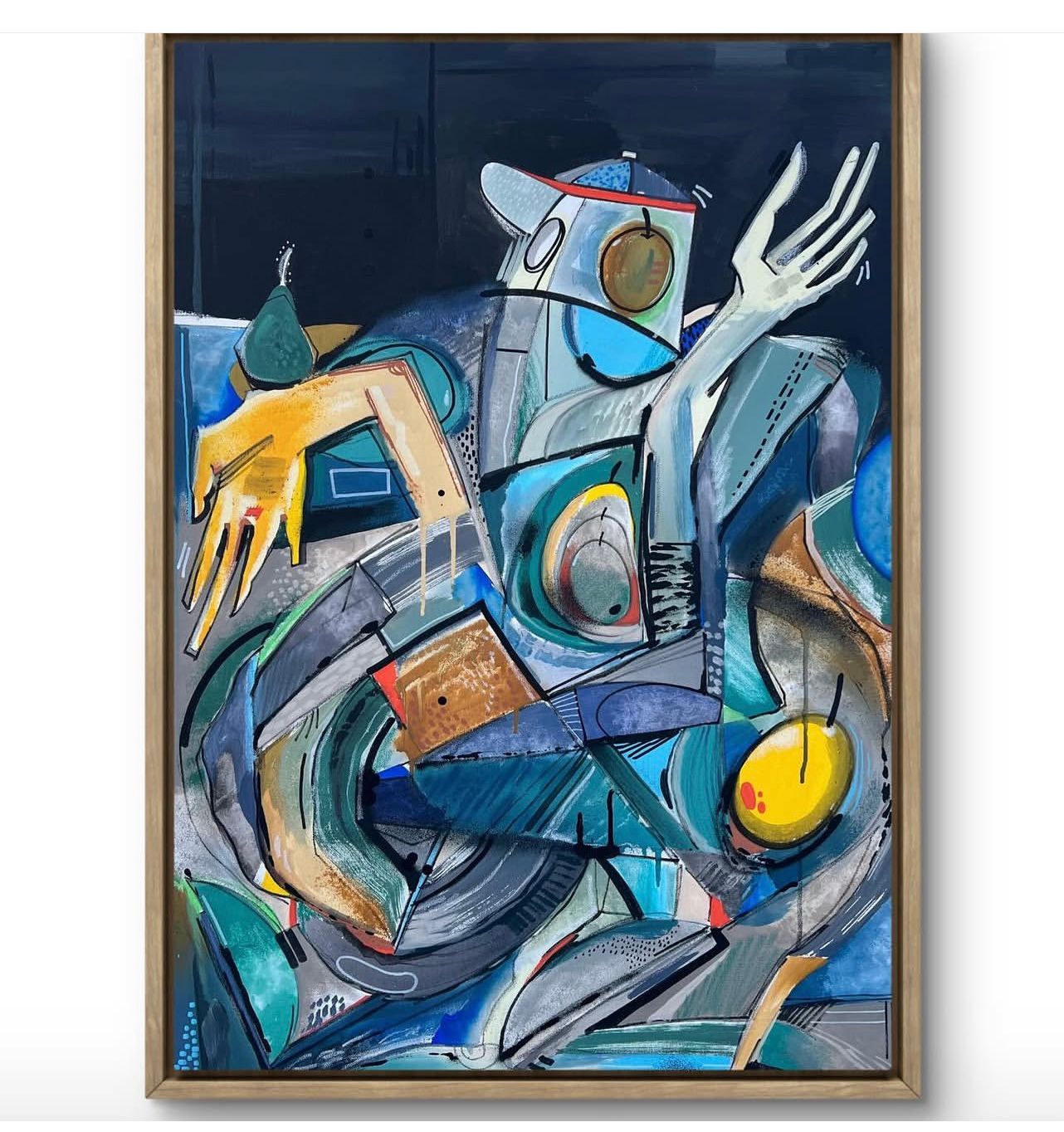
“My work is a dialogue between tangible reality and the fluid landscape of dreams. Through a visual language that oscillates between the abstract and the figurative, I translate personal experiences and fragments of fantasy onto the canvas. Within each composition, I preserve areas of pure, minimalist color—breathing spaces where the canvas remains free, inviting the viewer to pause.
As a guiding thread through this narrative, the constant presence of fruit serves as a tribute to my origins. At the beginning of my journey, within a context of simplicity and limited resources, the fruit I had at home became my first models and the foundation of my learning. Today, regardless of the subject I paint, they have become my hallmark: a symbol of resilience and memory that anchors the fantastic within the everyday, celebrating the very moment my art began.”
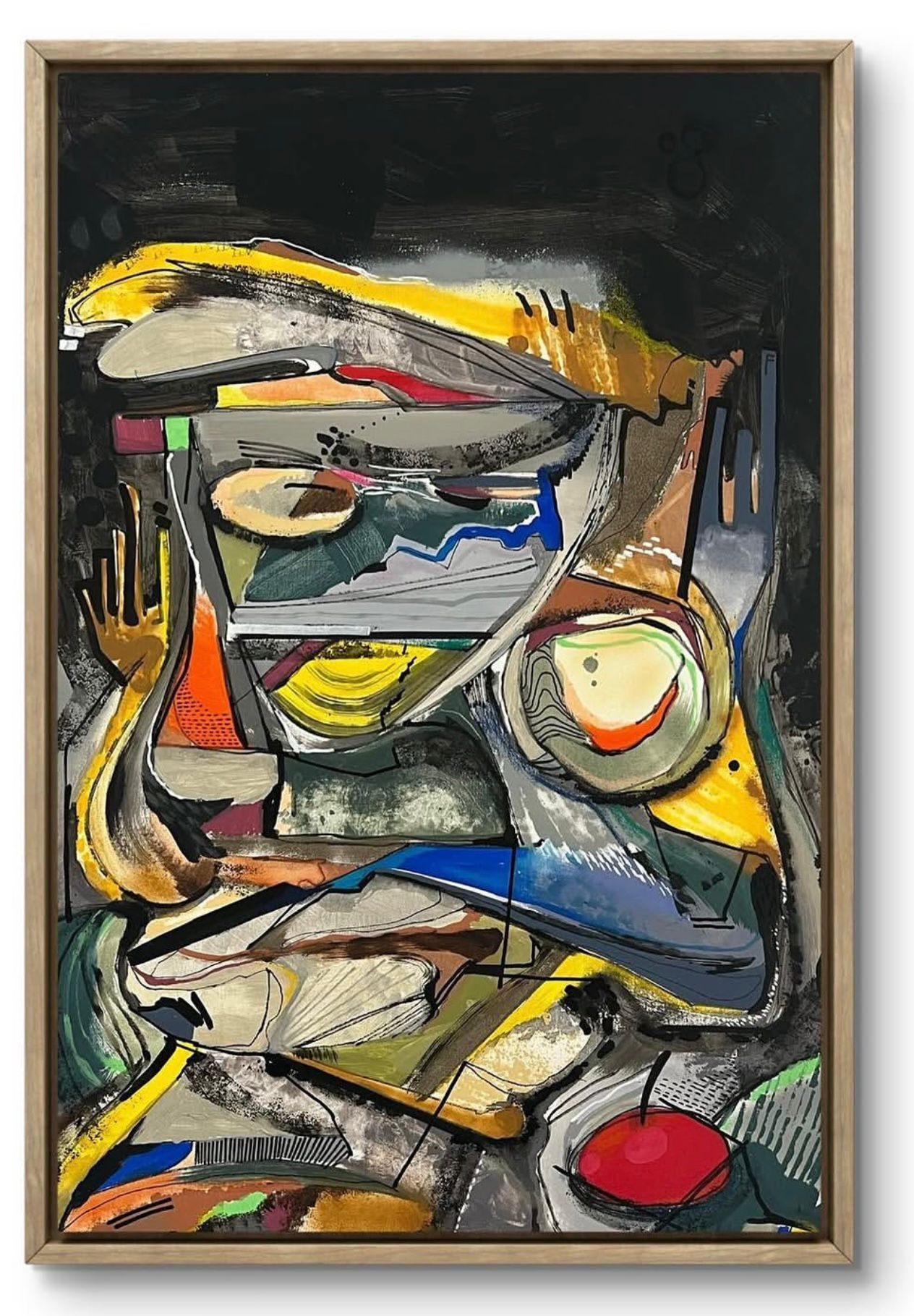
Artwork: The man who thought he should never pray again.
As we enter the room, we are confronted by the first painting. It is a face, but not an ordinary face. It is an identity constructed through layers. I see layers of gray, vibrant yellow, and touches of electric blue that merge and separate. There is a tension here; the bold black strokes seem to try to contain an overflowing emotion.
It is a portrait of the modern human mind: multifaceted, sometimes fragmented, but full of color. And there it is, in the lower corner, as promised: a red apple, solitary and perfect in the midst of graphic chaos. It is the point of anchorage, the first memory that prevents abstraction from getting completely lost.
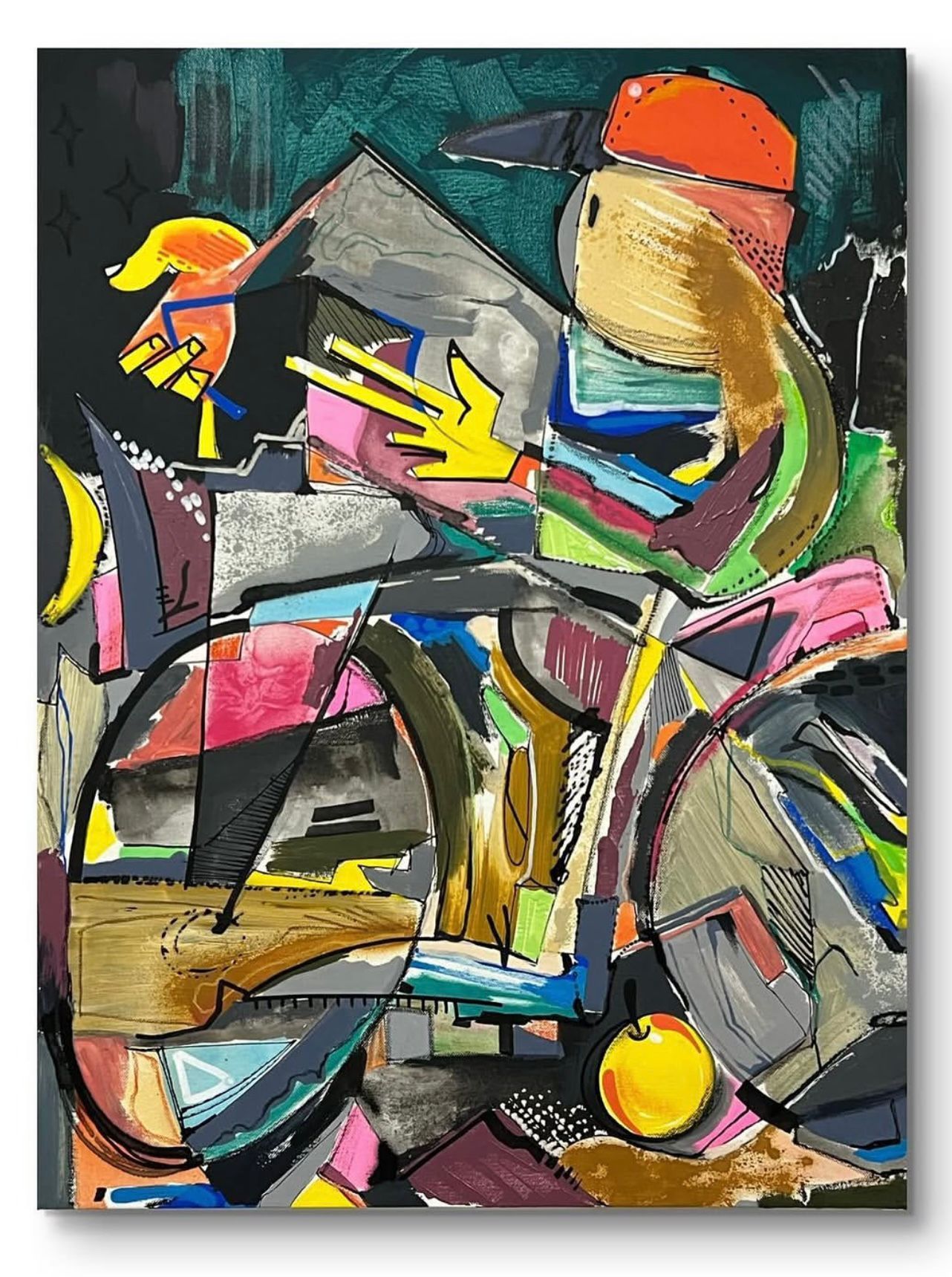
Artwork: The cyclist who stole fresh fruit.
Moving on to the second piece, the energy shifts. It is more dynamic, almost rhythmic. I identify a whimsical figure, with a vivid reddish-orange hat and what appears to be a beak. It is a creature straight out of the realm of dreams you mentioned.
The composition is more aggressive, with blocks of color (hot pink, lime green, deep black) that collide. The yellow hands gesture, telling a silent story. There is an implicit mechanical movement, like the gears of a fantastical clock. And on the floor of this dreamlike scene, a bright yellow sphere—another fruit, perhaps a lemon or a golden apple—shines like a jewel, linking this imaginary world to the reality of your personal story.
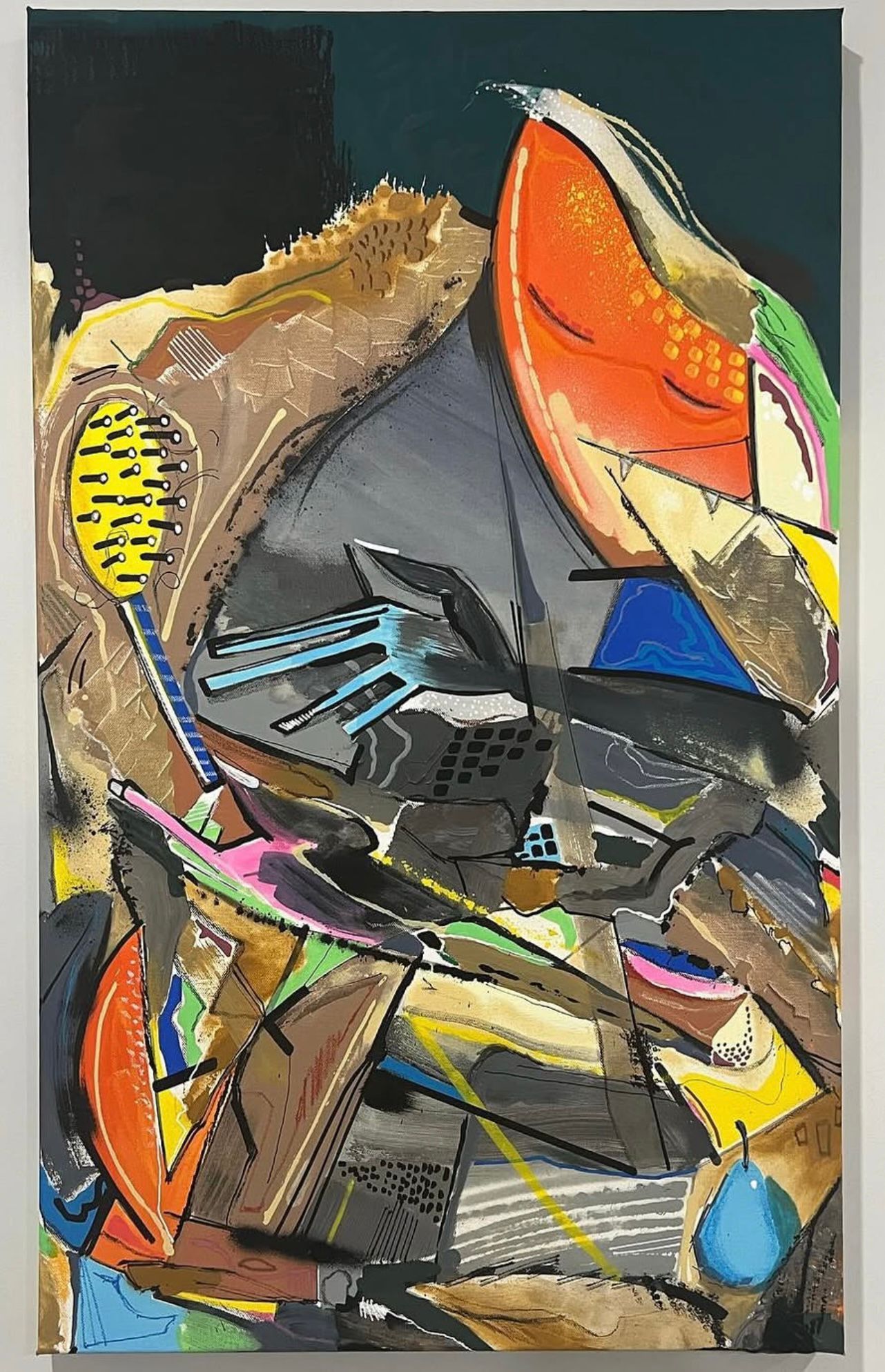
Artwork: The Woman who combed her hair until her hair fell out.
Finally, we arrive at the third work. This one seems more introspective. The upper part is dominated by a deep black mass, that “base color background” which functions like an abyss or a starless night sky. It is a space of silence.
Below, there is an organic and textured explosion. Shapes resembling scales or feathers in orange and green struggle for space with gray geometric structures. There is a peculiar object on the left: a striped handle that ends in a pointed yellow shape, resembling a brush or a reimagined everyday object. It is a collage of textures that invites touch. And, hidden within the complexity of the lower layers, a subtle blue form suggests the presence of yet another fruit, painted with the same reverence as the first ones you copied.
What I see in your paintings is a celebration of the complexity of life. You do not paint merely “ordinary situations”; you deconstruct reality and then reassemble it according to the logic of dreams.
Negative space (the deep blacks and clean grays) is not just a background; it is the stage where your colorful and fragmented world unfolds. And the fruits… they are like “signatures of the soul.” They give a sense of continuity and humanity to each piece, reminding the viewer that, behind all this vibrant abstraction, there is a real story of learning and memory.